

 Tiếng Việt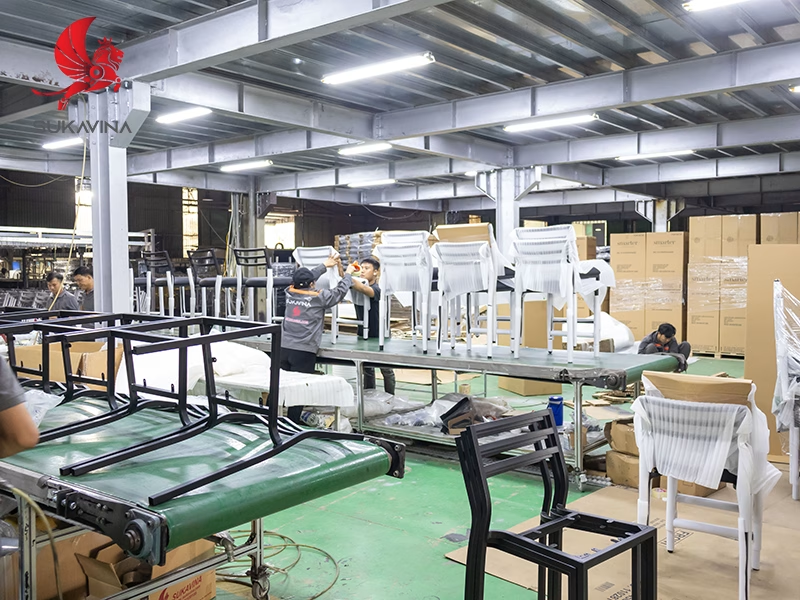
How to Optimize Metal Furniture Packaging for Export: KD, CBM & Container Loading
Optimizing metal furniture export packaging means balancing product protection, packaging cost, CBM (cubic volume), and container utilization — not simply minimizing package size. Buyers should compare knock-down (KD) and assembled configurations, review CBM per carton and per unit, evaluate nesting and stacking options, and request container loading data before approving packaging, because the configuration with the lowest CBM is not always the configuration with the lowest total logistics cost.
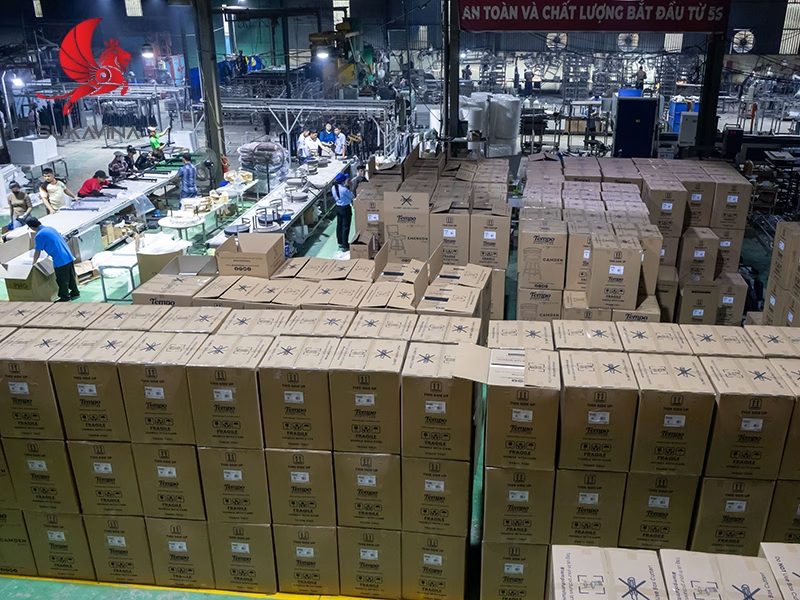
For metal furniture exported by ocean freight, packaging decisions affect three things at once: how well the product survives transit, how much space it occupies inside a container, and how much handling labor is required at origin and destination. For buyers in North America and the Middle East, where ocean shipments may pass through multiple handling points over an extended transit period, these decisions can directly affect landed cost and product condition.
Many buyers approach packaging with a single goal: reduce CBM to fit more units per container and lower freight cost per piece. This is a reasonable starting point, but it is incomplete. A configuration that minimizes volume while increasing damage risk, assembly labor, or handling complexity can raise total cost even as the freight invoice goes down.
This article treats metal furniture export packaging as a system: product design, KD vs. assembled construction, nesting and stacking, carton configuration, CBM, and container loading all interact. The buyer’s role is to review these trade-offs before approving a packaging plan — not simply to request the smallest box.
1. Why Does Packaging Matter for Metal Furniture Exports?
Metal furniture packaging serves two functions during export: protecting the product through multiple handling cycles, and controlling the volume and weight it occupies inside a container. Both functions carry a direct cost impact.
On the protection side, powder-coated or plated metal surfaces can be scratched, chipped, or corroded if packaging does not isolate parts from contact and moisture over a multi-week ocean transit. Tubular frames can also deform under uneven stacking pressure if cartons are not rated for the load stacked above them. Packaging quality should be reviewed alongside, not instead of, the product quality confirmed during metal furniture frame inspection — a well-built frame can still arrive damaged if the packaging does not match its actual handling and transit risk.
On the volume side, for LCL shipments, freight charges are commonly influenced by chargeable volume or weight, while FCL is generally quoted for the container. In both cases, packaging configuration affects the amount of cargo shipped for the logistics cost incurred.
Ask the factory whether they have relevant packing or transit experience for the same or a similar product, and request any available records or lessons from previous shipments.
2. KD vs. Assembled: Which Packaging Method Should Buyers Choose?
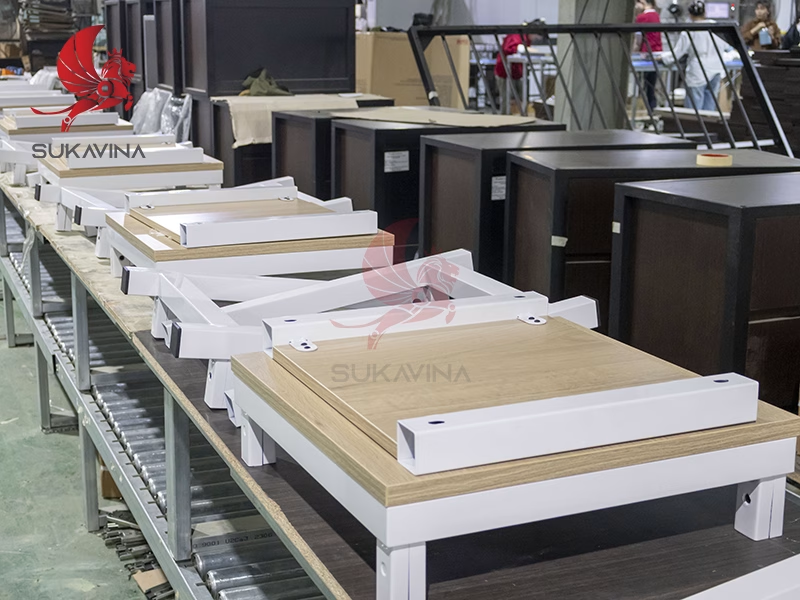
Knock-down (KD) packaging ships metal furniture disassembled — frames, legs, and hardware packed as flat or nested components for assembly at destination. Assembled packaging ships the product fully built and ready for use on arrival.
KD packaging generally reduces CBM per unit because components can be nested, laid flat, or packed more densely than a fully assembled shape allows. This is one reason KD is common for metal chairs, stools, stacking tables, and bolt-together shelving.
Assembled packaging is generally used when disassembly is impractical — one-piece welded frames, curved or sculptural forms, upholstered pieces where repeated assembly could loosen fasteners, or products where destination assembly labor is not available or not cost-effective.
| Factor | KD Packaging | Assembled Packaging |
|---|---|---|
| CBM per unit | Usually lower | Usually higher |
| Destination labor | Assembly required | None |
| Hardware/claim risk | Present (missing/loose parts) | Minimal |
| Best suited to | Bolt-together frames, stacking chairs | Welded, curved, or upholstered forms |
KD packaging is not automatically cheaper to land. Lower CBM can be offset by destination assembly labor, missing-hardware claims, or higher return rates if assembly instructions are unclear — factors that belong in the same decision as the freight comparison.
3. How Can Buyers Optimize CBM for Metal Furniture?
CBM (cubic meter) is the standard unit for ocean freight volume. For furniture, three figures matter to a buyer: CBM per carton, CBM per unit (carton volume divided by units inside it), and total CBM for the order.
CBM / carton = Length × Width × Height ÷ 1,000,000
(when carton dimensions are measured in mm)CBM / unit = CBM / carton ÷ Units / carton
CBM per unit is more useful for comparison than CBM per carton alone, because suppliers may propose different unit counts per carton. A carton with a higher total CBM but more units nested inside it can still produce a lower CBM per unit than a smaller carton holding fewer pieces.
Reducing CBM per unit is usually achieved through three levers: reducing product dimensions through KD disassembly, nesting or stacking components more efficiently within the carton, and minimizing unnecessary internal void space without compromising protection. These levers interact, so CBM optimization is better treated as a packaging design exercise than a single carton-size decision.
CBM per unit should always be requested alongside gross weight per unit. A carton with excellent CBM efficiency but excessive weight can still under-load a container if the shipment reaches the weight limit before the volume limit.
4. How Do Nesting and Stacking Reduce Packaging Volume?
Nesting packs components inside or against each other so their shapes share space rather than each occupying separate volume — for example, chair frames designed so one seat shell or frame profile sits partially inside the next, or tube sections bundled together rather than boxed individually.
Stacking arranges identical units vertically, either within a carton or on a pallet, using the product’s own structure — such as stackable chair frames — or protective interlayers to distribute weight evenly.
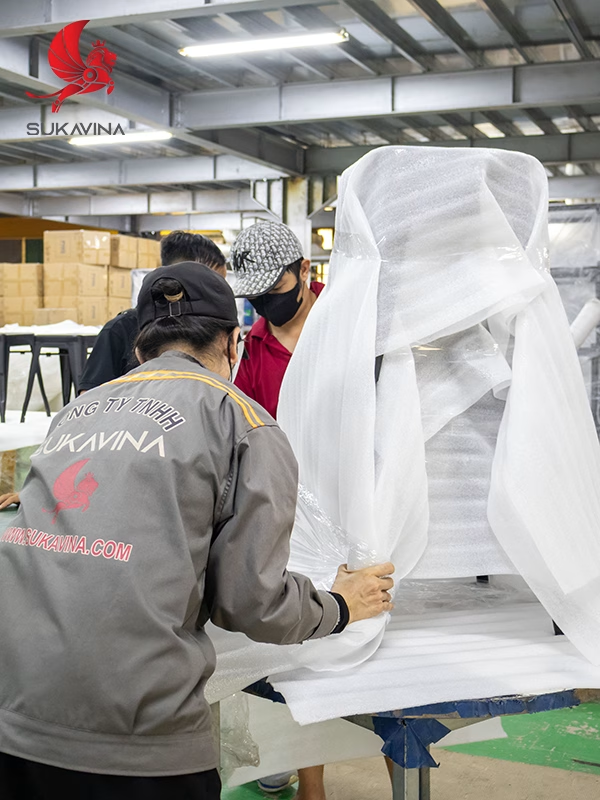
Both techniques reduce CBM, but both also depend on decisions made earlier in product design — frame geometry, leg spacing, and finish tolerance all affect how tightly parts can nest or stack without surface contact damage. This is why packaging efficiency is easier to achieve when it is considered during metal furniture OEM specifications, rather than added after tooling is finalized.
Protective interlayers — foam sheets, felt padding, or corner protectors — are usually required between nested or stacked metal parts to prevent powder-coat or plating damage from direct metal-to-metal contact, even when the nesting fit is precise.
5. How Should Carton Packaging Be Designed for Metal Furniture?
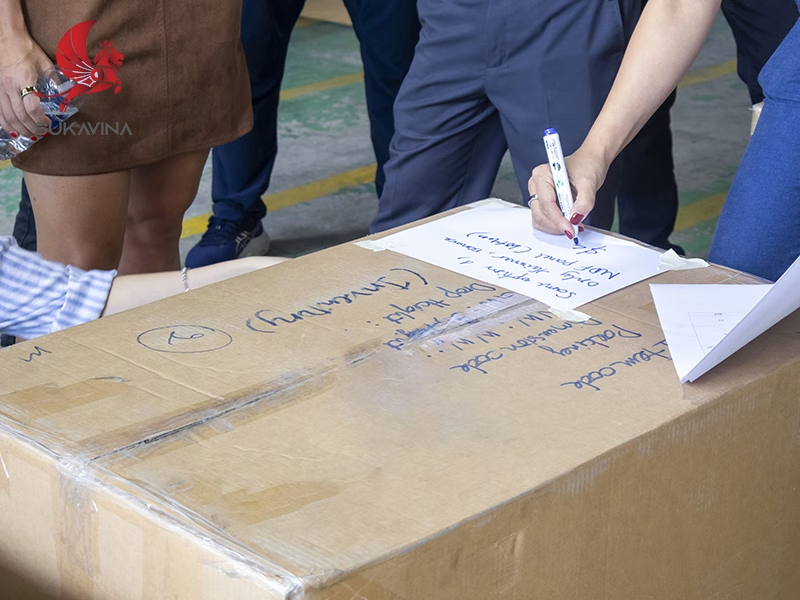
Carton design should follow the nesting or stacking configuration, not the reverse. A carton sized to the product’s natural nested footprint avoids both wasted internal volume and compression damage from an oversized, under-supported box.
Relevant carton specifications for metal furniture include board strength (single-wall vs. double-wall corrugated, or higher burst-strength board for stacked or floor-loaded cartons), corner and edge reinforcement, internal partitions or foam inserts separating components, and moisture-resistant coating or desiccant for humid-climate destinations.
Carton labeling should confirm unit count, gross and net weight, carton dimensions, and stacking orientation — including maximum stack height — information that also supports accurate container loading planning.
6. How Can Buyers Optimize Container Loading?

Container loading optimization starts with the carton dimensions and weight established during packaging design, then applies them to a specific container type — commonly 20-foot, 40-foot, or 40-foot high-cube for furniture exports.
A loading plan, sometimes called a stuffing plan or loading diagram, shows how cartons or pallets are arranged inside the container, including orientation, stacking pattern, and any bracing or dunnage used to prevent shifting during transit. Reviewing this plan — not only the final units-per-container figure — lets a buyer confirm the loading pattern matches the carton’s rated stacking limits.
Mixed-SKU containers, carrying multiple products in one container, require additional planning, since cartons of different sizes and weights must be sequenced to avoid both wasted space and uneven weight distribution.
7. Why Is CBM Not the Only Factor in Container Utilization?
Container utilization is limited by two independent constraints: cubic volume (cube-out) and maximum payload weight (weight-out). Metal furniture can reach practical weight constraints before available container volume is fully used, depending on the product mix, packaging configuration, and container type..
Product shape also affects real-world utilization differently than a CBM calculation suggests. Irregular shapes, protruding components, or parts that cannot be stacked create dead space that a theoretical CBM-per-unit figure does not capture, particularly for assembled or partially assembled items.
Handling and fragility considerations can also limit stack height below what a carton’s compression rating would otherwise allow, especially for cartons containing finished or glass-inclusive components.
Two packaging configurations with identical CBM per unit can still load a different number of units per container once weight limits, stacking restrictions, and real container geometry are applied. Always request the actual units-per-container figure for the specific container type, not only the CBM-per-unit calculation.
8. Floor-Loaded vs. Palletized: Which Is Better for Export Furniture?
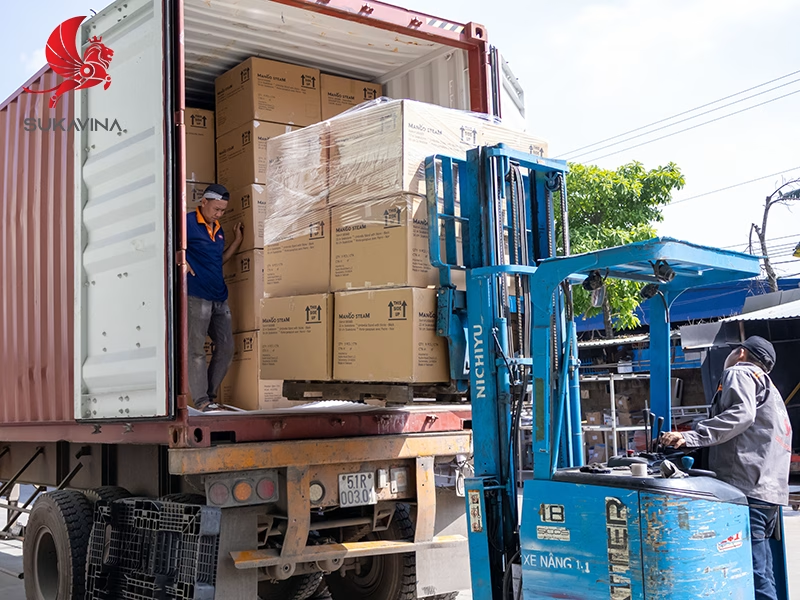
Floor-loading places cartons directly on the container floor, typically stacked and hand-packed to fill the space as tightly as possible. This generally achieves the highest CBM utilization but requires more loading labor and more careful bracing to prevent shifting.
Palletizing groups cartons onto pallets before loading. Pallets simplify handling with forklifts at both origin and destination — an advantage in markets, including much of North America, where warehouse unloading is mechanized and turnaround time matters. The trade-off is reduced CBM utilization, since pallet dimensions and the surrounding clearance add volume that floor-loading avoids.
The better choice depends on the destination’s unloading capability, the buyer’s warehouse handling method, and the value of faster unloading against the freight cost of the extra volume pallets occupy. Some buyers use a hybrid approach — floor-loading most of a container’s volume and palletizing only where destination handling requires it.
9. How Should Buyers Balance Packaging Cost and Freight Cost?
Packaging cost (carton material, foam, labor, and any pallets) and freight cost, driven largely by CBM and weight, move in different directions. More protective packaging generally increases packaging cost and can increase CBM, while lighter, more compact packaging reduces both — up to the point where protection becomes inadequate.
The total logistics cost a buyer should evaluate includes freight, packaging cost, and the expected cost of damage claims, replacements, or returns caused by under-protection. A configuration with slightly higher CBM but a materially lower damage rate can produce a lower total cost per landed unit than the cheapest, most compact option.
Request cost and CBM data for at least two packaging options — a standard configuration and a volume-optimized configuration — so freight savings can be weighed directly against any change in packaging cost or protection level before approval.
10. What Packaging and Loading Data Should Buyers Request From a Factory?
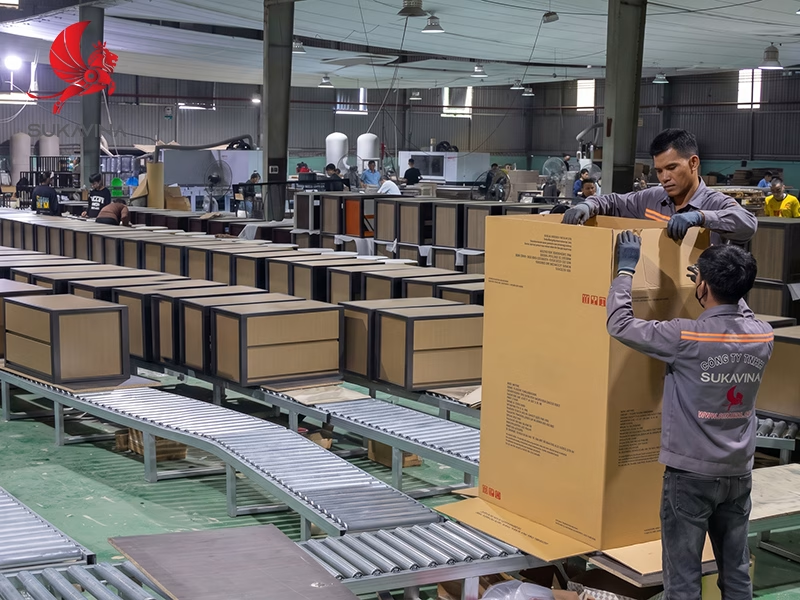
Before approving packaging, buyers should request a specific data set rather than a general description. At minimum this includes: carton dimensions and CBM per carton, units per carton, CBM per unit, gross and net weight per carton, units per container by container type (20ft / 40ft / 40HQ), and a loading plan or diagram showing the stacking pattern.
This data should be requested as part of the furniture OEM RFQ process, alongside product and material specifications, so packaging assumptions are documented before production rather than negotiated after cartons are already built.
When this data is available in a consistent format, it also becomes possible to compare furniture manufacturer quotes on an equal basis — a lower unit price paired with a higher CBM per unit or a less protective packaging spec is not necessarily the lower-cost option once freight and damage risk are included.
11. Example: Comparing Two Packaging Configurations for a Metal Chair
The comparison below is an illustrative example only, intended to show how packaging configuration affects CBM, container loading, and total cost. Actual figures vary by product, factory, and destination.
| Metric | Config A — Assembled, boxed individually | Config B — KD, nested/stacked, 4/carton |
|---|---|---|
| CBM / carton | ~0.14 m³ | ~0.32 m³ |
| Units / carton | 1 | 4 |
| CBM / unit | ~0.14 m³ | ~0.08 m³ |
| 40HQ Container Space Utilization* | Lower | Higher |
| Destination assembly | None | Minor (bolt-on legs) |
| Packaging cost / unit | Lower | Slightly higher (interlayers, hardware bags) |
*Hypothetical figures for illustration only, assuming full cube-out with no weight restriction. Actual results depend on the product, container type, and loading method.
In this simplified example, Configuration B achieves a lower CBM per unit and a higher theoretical loading capacity. The buyer would still need to validate actual loading, weight limits, assembly labor, hardware management, and product protection before approving the configuration.
12. Metal Furniture Export Packaging Checklist
- ☐ CBM per carton and CBM per unit confirmed
- ☐ Units per carton and units per container confirmed by container type
- ☐ Gross and net weight per carton confirmed
- ☐ KD vs. assembled decision reviewed against product design and destination assembly capability
- ☐ Nesting/stacking configuration reviewed for finish protection
- ☐ Carton board strength and internal protection specified
- ☐ Loading plan or diagram reviewed, not only the final unit count
- ☐ Floor-loaded vs. palletized method confirmed against destination handling
- ☐ Packaging cost compared against freight savings and damage risk
- ☐ Packaging sample or packing trial reviewed before mass production
13. Conclusion
The best export packaging for metal furniture is not the smallest package or the lowest CBM figure. It is the configuration that protects the product, fits the intended container type efficiently, and produces the lowest realistic total cost once freight, packaging, handling, and damage risk are considered together.
Buyers who request CBM, weight, and loading data early, compare KD and assembled options against their own destination handling capability, and review the loading plan before approval are better positioned to control landed cost — without discovering damage or capacity problems after the container has sailed.
FAQs
1. Does KD (knock-down) packaging always reduce shipping cost for metal furniture?
Not always. KD packaging typically reduces CBM per unit, which can lower freight cost per piece, but it may add destination assembly labor, hardware handling, and assembly-related claims. The net cost impact depends on the product, the buyer’s assembly capability, and the specific packaging configuration used.
2. How many units of metal furniture fit in a 40-foot high-cube container?
There is no universal figure. Units per container depend on the product’s dimensions, whether it is KD or assembled, the nesting and stacking configuration, carton design, and whether the container is floor-loaded or palletized. Buyers should request a specific units-per-container figure — and a loading plan — for their exact product and packaging configuration.
3. Is floor-loading always more cost-effective than palletized loading for export furniture?
Not necessarily. Floor-loading typically improves CBM utilization and reduces per-unit freight cost, but palletizing can reduce destination unloading time and labor in markets with mechanized warehouse handling. The better option depends on the destination’s unloading capability and how that cost compares to the freight savings from higher container utilization.
Reviewing Packaging and Container Loading for an Upcoming Order?
Sukavina Furniture works with OEM buyers to review KD vs. assembled options, CBM efficiency, and container loading plans as part of metal furniture export projects.
- Address: Binh Chuan 44 St, An Phu Ward, Ho Chi Minh City, Vietnam.
- Hotline/WhatsApp/WeChat: +84 979 034 634 / +84 931 155 155
- Mail: sales@vietmetalfurniture.com
- Website: vietmetalfurniture.com/en