

 Tiếng Việt
How to Define Metal Furniture OEM Specifications
Metal furniture OEM specifications should define what the finished product must be, look like, and perform like — material, tube profile, dimensions, critical tolerances, welding appearance, surface finish, hardware, and packaging — while leaving the manufacturing method itself to the factory. A clear specification lets a supplier quote, sample, and produce consistently, because pricing, engineering, and production planning all rely on the same agreed requirements instead of assumptions.

Before a metal furniture factory can quote accurately, build a sample, or run production, both sides need to agree on what is actually being made. Many buyers start sourcing with a furniture OEM RFQ describing the product in general terms — a photo, a rough sketch, a target price. A specification is different from an RFQ: an RFQ asks a factory to respond; a specification tells the factory exactly what it is responding to.
When specification details are missing, factories fill the gaps with their own assumptions. This is where quotations start to diverge, samples miss expectations, and later attempts to compare furniture manufacturer quotes stop being a fair comparison — because each factory quoted a slightly different, self-assumed product.
This article focuses on what needs to be agreed before a factory begins engineering, tooling, or cutting metal — not on evaluating what comes out the other end. Checking finished frames against the agreed requirements is a separate step, covered under metal furniture frame inspection. Here, the focus is the specification stage: what a buyer should define, what a manufacturer should recommend or engineer, and what happens when that line is left unclear.
1. What Should a Metal Furniture OEM Specification Include?
A complete set of metal furniture OEM specifications typically covers eight categories: material, tube profile and wall thickness, dimensions and tolerances, welding, load and performance, surface finish, hardware and assembly, and packaging. Not every category needs the same level of buyer detail — the goal is functional and commercial clarity, not a full engineering drawing.
A useful way to organize metal furniture technical specifications is to separate what the buyer defines from what the manufacturer is better positioned to determine, as outlined below.
| Specification Area | Buyer Typically Defines | Manufacturer Typically Recommends |
|---|---|---|
| Material | Material family, intended environment, appearance | Exact grade sourcing, mill selection |
| Tube profile & size | Shape, outer dimension, visual proportion | Wall thickness, tolerance class, tube standard |
| Dimensions & tolerances | Overall size, critical fit dimensions | Tolerance range by geometry and process |
| Welding | Joint appearance, visible vs. hidden welds | Welding process, sequence, fixturing |
| Load & performance | Intended use, environment, applicable standard (if any) | Reinforcement design, test method selection |
| Surface finish | Finish type, color reference, sheen level | Pre-treatment, coating parameters |
| Hardware & assembly | KD vs. assembled, visible hardware preference | Fastener type, glide/leveler engineering |
| Packaging | KD/assembled shipment, protection level, labeling | Carton construction, internal packing method |
A specification does not need to define every engineering parameter. It needs to define every requirement that affects fit, function, appearance, durability, and cost — and clearly indicate which decisions are left to the manufacturer’s engineering judgment.
2. How Should Buyers Specify Metal Material?

“Steel” or “metal” alone is not a usable material specification. At minimum, OEM furniture specifications should state the material family — cold-rolled mild steel, a stainless steel type, or an aluminum alloy — along with the intended environment (indoor, outdoor, coastal, high-humidity) and the general appearance direction, such as a smooth painted finish versus an exposed brushed-metal look. Where a project or client specification requires a specific material grade, the buyer should state that grade explicitly rather than leaving it to manufacturer recommendation.
Within that family, exact chemical composition, mill sourcing, and grade optimization are usually decisions the manufacturer is better positioned to make. A factory that regularly forms, welds, and finishes a given material family understands how small variations within it affect bending behavior, weld quality, and coating adhesion — details a buyer rarely needs to specify directly.
Material choice affects how a frame welds, bends, and holds a coating. For this reason, material family should be confirmed early — before tube profile and welding requirements are finalized — since revisiting the material later can require re-engineering the frame.
3. What Tube Size and Wall Thickness Should Buyers Define?
Metal furniture tube specifications generally start with two buyer-facing decisions: the tube profile (round, square, or rectangular) and the outer dimension needed to achieve the intended design proportions, usually driven by the product’s visual design and basic structural role — a slim round leg versus a wider square frame rail, for example.
Wall thickness is a different matter. There is no single wall thickness that fits every product or price point; it depends on the component’s structural role, the tube’s outer dimension, joint design, and intended use. Because of this, wall thickness is best treated as a manufacturer recommendation guided by the buyer’s stated functional requirement — light residential use, heavier commercial use, outdoor exposure, or a stacking/nesting application — rather than a number the buyer sets independently. Those functional inputs let the factory propose metal furniture frame specifications, profile, dimension, and wall thickness together, that are appropriate to the product rather than generic.
When comparing supplier quotations, confirm exact tube outer diameter and wall thickness in millimeters rather than relying on general gauge references, since gauge naming conventions and rounding practices can differ between regions and suppliers.
4. Which Dimensions and Tolerances Should Be Specified?
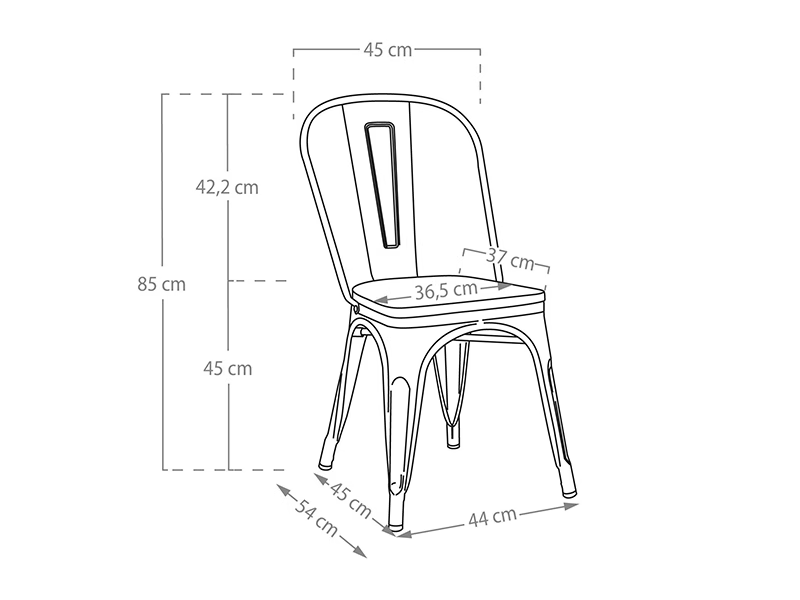
Not every dimension on a metal furniture frame carries the same weight. Critical dimensions affect fit, function, structural connection, or interchangeability with other components — seat height, leg spread relative to a tabletop, or hole spacing for hardware, for example. Non-critical dimensions are typically decorative or have a wider acceptable range, such as the exact length of a stretcher bar’s decorative curve.
Buyers should identify overall functional dimensions and flag which ones are critical. Metal furniture tolerance specifications — the acceptable range of variation around each dimension — should then be agreed according to the product’s geometry, its manufacturing process, the functional requirement at stake, and any applicable specification. There is no universal tolerance value across tube bending, stamping, laser cutting, and assembly; a tolerance appropriate for a decorative bracket is not automatically appropriate for a load-bearing joint.
Marking a dimension as “critical” tells the manufacturer where precision matters most. Leaving every dimension unmarked, or treating all of them as equally important, makes it harder for a factory to prioritize tooling and inspection effort where it actually affects the buyer.
5. What Welding Requirements Should Be Included?

Metal furniture welding specifications at the pre-production stage are about intent, not method. Buyers are generally best positioned to define which joints are structural, which welds will be visible, and what appearance is expected at those joints — for example, whether a seam should be ground smooth and invisible under the finish, or is acceptable as a visible bead consistent with an industrial design language.
Selecting the welding process itself — MIG, TIG, spot, or robotic welding — along with joint design, sequence, and fixturing, is a manufacturing decision that depends on the factory’s equipment, material thickness, and production volume. It is generally best left to the manufacturer’s engineering team once the buyer’s appearance and structural expectations are clear.
Specifying an outcome — “no visible weld spatter on outer frame surfaces,” or “leg-to-rail joints ground flush before coating” — is usually more actionable for a factory than specifying a welding method by name, since the outcome is what a buyer will actually evaluate later. How welds are checked against these expectations belongs to the frame inspection stage rather than the specification stage.
6. How Should Buyers Define Load and Performance Requirements?
Load and performance requirements are among the metal furniture technical requirements most often left vague, largely because buyers assume a factory will “know” what is needed for a given furniture type. In practice, these expectations depend on product type, intended use, the environment the product will sit in, and — for many contract and hospitality projects — an applicable standard specified by the project owner, specifier, or destination market.
Buyers should state the intended use case (residential, light commercial, heavy contract, outdoor), the general environment, and whether a specific standard applies to the project. A BIFMA reference, for instance, is relevant to some commercial furniture programs in North America, but it is not a universal requirement for all metal furniture and should be confirmed only where the project or market calls for it. There is no single load figure, test duration, or acceptance criterion that applies across all metal furniture categories; these should be set by the applicable standard or project specification, not assumed. Once use and any applicable standard are defined, structural reinforcement, joint adjustments, and test method selection are engineering decisions the manufacturer is generally better equipped to make.
For hospitality, healthcare, and other contract projects, the applicable performance standard is often set by the project specifier rather than chosen independently by the furniture buyer. Confirming this early avoids redesigning a frame after samples have already been approved.
7. What Surface Finish Specifications Should Buyers Define?

Metal furniture finish specifications should identify the finish type (powder coat, electroplating, brushed or polished metal, wet paint), a color reference the factory can match against — a standard color code or a physical sample, not a description like “dark gray” — and the intended sheen level, such as matte, satin, or gloss.
Buyers should also indicate the durability expectation implied by end use — an outdoor or coastal application generally calls for a different pre-treatment and coating approach than an indoor residential piece. Exact pre-treatment process and coating thickness parameters vary by substrate, coating type, application method, and environment, so these are appropriately left to the manufacturer’s recommendation rather than fixed by the buyer as a universal number. Where durability or corrosion resistance is a project requirement, the specification should also state the applicable performance or test requirement rather than relying only on a visual color match.
8. What Hardware and Assembly Requirements Should Be Specified?
Buyers should state whether the product ships knock-down (KD) or fully assembled, whether fasteners should be visible or concealed, any preference on assembly method — bolted, cam-lock, or welded-fixed — and whether glides, levelers, or felt pads are needed for uneven flooring in the destination market.
The specific fastener types, glide or leveler engineering, and assembly sequence are typically manufacturer recommendations, matched to the frame’s material, wall thickness, and finish. A visible fastener on a painted frame, for example, is usually specified to match the coating color — worth stating if it matters, since a factory will otherwise default to a standard hardware finish.
9. Should Packaging Be Part of the OEM Specification?
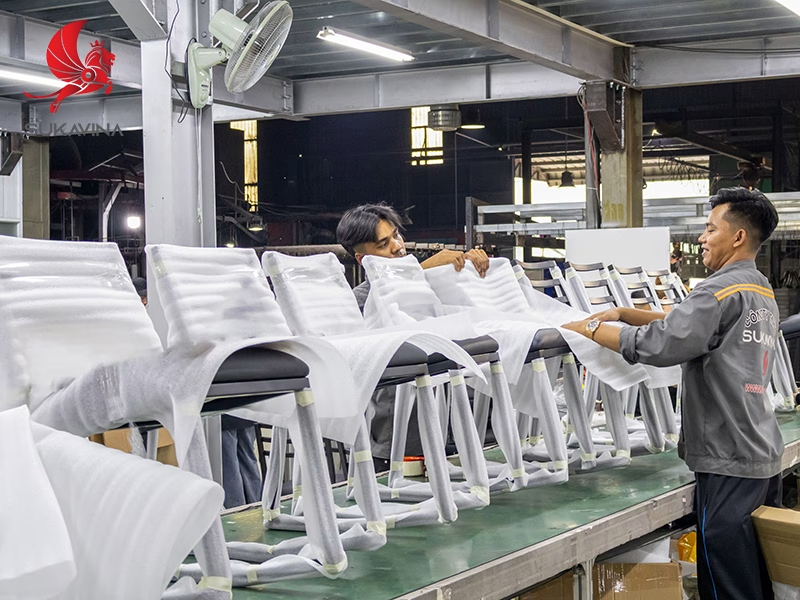
Packaging decisions affect protection, assembly labor at destination, and landed cost, which is why they belong in the specification document rather than a later conversation. At this stage, buyers should define whether the product ships KD or assembled, the level of component protection required (foam interleaving, corner protectors, individually bagged hardware), labeling requirements (carton marking, barcoding, included assembly instructions), and any instructions specific to the buyer’s retail or project requirements.
The specific carton construction and internal packing method are generally a manufacturer recommendation, based on the product’s shape, weight, and fragility. Deeper packaging topics — carton dimension optimization, nesting, and container loading efficiency — are a separate discussion once basic requirements are confirmed; they fall under metal furniture export packaging rather than the initial specification.
10. How Should Buyers Turn Specifications Into a Production-Ready Document?
Individual requirements scattered across emails, chat messages, and reference photos are difficult for a factory to engineer against consistently. A production-ready metal furniture OEM specification typically consolidates several elements into one document or document set:
- Technical drawing — overall dimensions, critical dimensions and their tolerances clearly marked, and construction or joint notes.
- Bill of materials (BOM) — material, tube sizes, hardware, and finish components listed against each part.
- Finish requirements — finish type, color reference, and sheen level.
- Hardware requirements — fastener types, glides/levelers, and assembly method.
- Packaging requirements — KD/assembled shipment, protection level, and labeling.
- Revision and version control — a dated version number and sign-off record so every party works from the same current specification.
Version control matters more than it appears to at first. Specifications are usually refined across sample rounds, and without a clear version history, a factory can easily produce against an outdated requirement while the buyer believes a later change was already applied. A simple date-stamped version number with written sign-off on each revision prevents this — and this same document becomes the shared reference buyers use when they compare furniture manufacturer quotes across more than one factory, since a common specification is what makes multiple quotations genuinely comparable.
11. What Happens When Metal Furniture Specifications Are Too Vague?
A vague specification does not necessarily produce a bad product — it produces an unpredictable one. When key details are left open, different factories interpret the gaps differently, and each interpretation is a reasonable response to incomplete information rather than an error on the factory’s part.
Vague specification: “Legs: 25mm steel tube, powder coated black.”
Production-ready rewrite: “Legs: 25 mm OD round mild steel tube; wall thickness to be recommended by the manufacturer based on the specified load requirement. Finish: Matte black powder coat, color reference RAL 9005, suitable for indoor commercial use. Welding: Leg-to-frame welds to be ground smooth before coating, with no visible spatter or pronounced weld marks on the outer leg surfaces.”

The vague version leaves wall thickness, exact black shade, sheen level, and weld appearance open to interpretation. One factory might reasonably quote a thinner-wall tube with a glossy near-black finish; another might quote a heavier-wall tube with a true matte finish and extra grinding time built into the price. Neither factory has done anything wrong — they responded to different implied specifications, which is precisely why the two quotations, samples, and finished products would differ.
Left unresolved, this pattern tends to compound: quotation differences get mistaken for pricing competitiveness, samples get rejected for reasons never written down, unplanned material or process substitutions surface late, and disagreements arise over what was actually “agreed” — usually well after tooling or purchasing has begun.
12. Metal Furniture OEM Specification Checklist
A short metal furniture specification checklist like the one below is a practical way to confirm nothing essential has been left undefined before a factory begins engineering or sampling.
- ☐ Material family, environment, and appearance direction confirmed
- ☐ Tube profile and outer dimension defined
- ☐ Functional load/use case stated so wall thickness can be recommended
- ☐ Overall functional dimensions listed, with critical dimensions flagged
- ☐ Tolerance expectations agreed for critical dimensions
- ☐ Welding appearance and structural expectations described
- ☐ Intended use, environment, and any applicable standard stated
- ☐ Finish type, color reference, and sheen level defined
- ☐ KD vs. assembled and hardware visibility preference stated
- ☐ Packaging protection, labeling, and shipment format defined
- ☐ Technical drawing and BOM attached
- ☐ Document version dated and signed off by both sides
13. Conclusion
A factory can only manufacture consistently what the buyer and manufacturer have clearly agreed to define. Well-defined metal furniture OEM specifications do not require the buyer to independently determine every engineering parameter — they require the buyer to define functional, dimensional, material, appearance, and performance intent clearly enough for the manufacturer’s engineering team to recommend the right profile, process, and construction method within that intent. Getting this stage right pays off later, in quotations that are genuinely comparable, samples that match expectations early, and production runs that stay consistent across a full order — well before frames ever reach the inspection stage.
FAQs
1. Do buyers need engineering knowledge to write a metal furniture OEM specification?
No. Buyers are not expected to determine engineering parameters such as exact wall thickness, tolerance ranges, or welding methods independently. What matters is defining functional, dimensional, appearance, and performance intent clearly enough that the manufacturer’s engineering team can recommend suitable materials, profiles, and production methods within that intent.
2. Is BIFMA required for every metal furniture OEM specification?
No. BIFMA is a relevant reference for some commercial furniture programs, particularly in North America, but it is not a universal requirement for all metal furniture. Buyers should confirm whether their specific project, client, or destination market calls for a particular standard rather than assuming one applies by default.
3. Should specifications be finalized before or after sampling?
Core specifications — material, tube size, critical dimensions, welding appearance, finish, and hardware intent — should be defined before the first sample is built. It is normal for details to be refined during sample review; any changes should be captured in a revised, version-controlled document and signed off before mass production begins.
Preparing an OEM Metal Furniture Project?
Sukavina Furniture works with international buyers on specification development, technical review, and sample preparation for OEM metal furniture programs.
- Address: Binh Chuan 44 St, An Phu Ward, Ho Chi Minh City, Vietnam.
- Hotline/WhatsApp/WeChat: +84 979 034 634 / +84 931 155 155
- Mail: sales@vietmetalfurniture.com
- Website: vietmetalfurniture.com/en