

 Tiếng Việt
How Should Buyers Inspect a Metal Furniture Frame Before Mass Production?
Before approving mass production, buyers should compare the pre-production sample against the technical drawing for dimensions and tolerances, confirm tube diameter, wall thickness, and material grade, check weld quality and joint alignment, test frame squareness and stability, verify load-bearing performance, review surface finishing consistency, and confirm hardware and assembly fit. Approval should be based on measured data and signed documentation, not visual impression, because a single sample has to be reproducible across an entire production run.
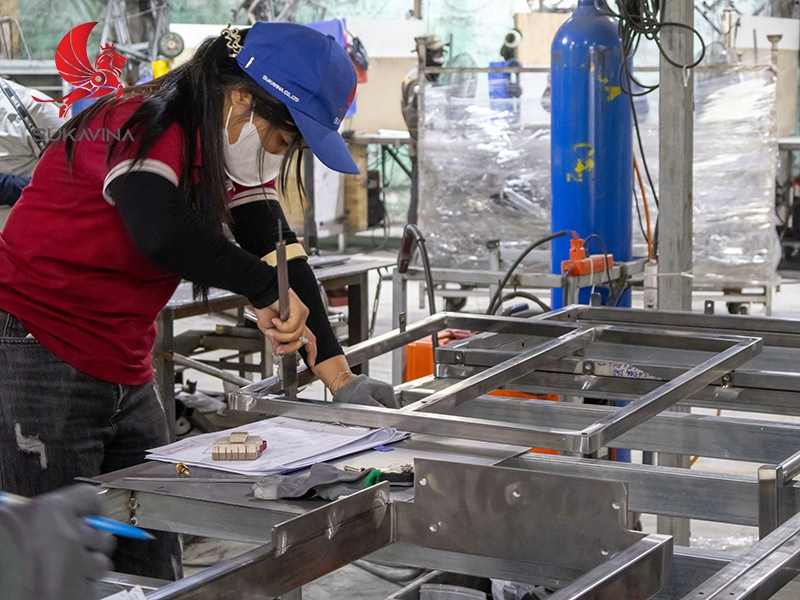
For most metal furniture programs, the pre-production sample is the last checkpoint before a buyer commits to tooling, jigs, coating batches, and raw material purchasing. Once mass production starts, a frame problem is no longer a single-piece issue — it becomes a container-level issue. A structured metal furniture frame inspection at this stage is what separates a buyer who catches a tolerance or weld defect on one sample from a buyer who discovers it on three hundred finished chairs.
This guide is written from the buyer’s side of the table, not the factory’s. It follows the practical approval sequence most experienced OEM buyers already use: technical drawing, sample, inspection, deviation review, approval, mass production. Each section below explains what to check, why it matters, and how to document the decision so it can be enforced later if production drifts from the approved sample.
1. Why Should Buyers Inspect the Frame Before Mass Production?

A metal furniture frame carries the structural load of the finished product. If a dimensional error, a weak weld, or an inconsistent finish passes into mass production undetected, the cost of correcting it multiplies at every stage that follows — cutting, bending, welding, coating, assembly, and packing. By the time a container is loaded, a frame defect is no longer a production problem; it is a claims, rework, and relationship problem.
Pre-production inspection is important because a sample is not automatically representative of what a factory can reproduce at volume. A skilled sample maker can hand-finish a single frame to a standard the production line will not consistently achieve with standard jigs, less experienced welders, and faster cycle times. Inspecting the frame before mass production is how a buyer confirms that what was approved on paper and in the sample is actually achievable at scale.
A sample approval is not a decision about one frame. It is a decision about the tolerance range, weld standard, and finish quality the buyer is willing to accept across every unit in the order.
2. What Should Buyers Check on a Metal Furniture Frame?
A complete metal furniture quality inspection at sample stage covers seven areas. Each one answers a different question about the frame’s construction, and each one should be checked and recorded separately rather than judged as a single overall impression.
| Inspection Area | What the Buyer Confirms |
|---|---|
| Dimensions & tolerances | Overall size, seat height, leg spread, and critical dimensions match the drawing within stated tolerance |
| Tube specification | Tube diameter, wall thickness, and material grade (mild steel, stainless steel, aluminum) match the quotation |
| Weld quality | Weld penetration, bead consistency, and grinding finish at every structural joint |
| Squareness & alignment | Frame sits flat, legs are level, and diagonal measurements match |
| Load-bearing performance | Frame holds its rated static and dynamic load without permanent deformation |
| Surface finishing | Coating thickness, adhesion, color match, and coverage at welds and edges |
| Hardware & assembly fit | Fasteners, connectors, and pre-drilled holes align without forcing |
3. Is the Frame Square, Stable, and Properly Aligned?
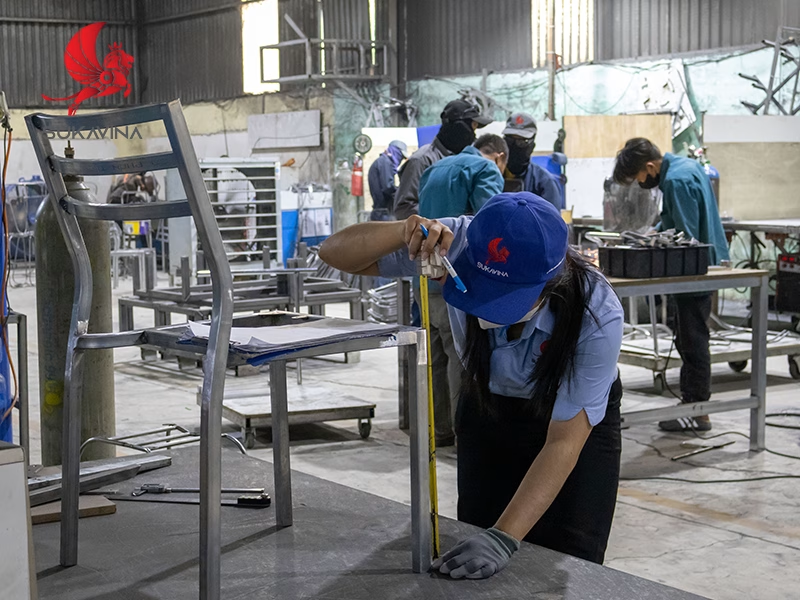
A frame can pass a visual check and still be structurally off. Squareness and alignment are best confirmed with three simple tests that any buyer or third-party inspector can perform without special equipment.
First, the diagonal test: measure both diagonals of a rectangular frame base. A difference beyond the agreed tolerance indicates the frame is out of square, even if each individual side measures correctly. Second, the flat-surface test: place the frame on a known flat surface and check for rocking at any leg. A frame that wobbles on a flat floor will wobble in the customer’s home or venue. Third, a visual alignment check along each leg and stretcher, looking for bowing, twisting, or misaligned welds that pull the structure out of plane.
There is no universal diagonal tolerance for every metal furniture frame. Buyers should define the acceptable deviation on the technical drawing based on the frame’s size, construction, and intended application. A measurable difference between diagonals can indicate squareness issues and should be evaluated against the agreed tolerance rather than judged visually.
4. How Should Buyers Check Load-Bearing Performance?
Load-bearing performance is one of the most important functional checks for a metal furniture frame, particularly for chairs, tables, beds, and other products used in commercial environments. At sample stage, buyers should verify that the frame can withstand the agreed test load and test conditions without permanent deformation, weld cracking, joint separation, or other signs of structural failure. The test load, loading position, duration, number of cycles, and acceptance criteria should be defined according to the product’s intended use and the applicable testing standard or project specification. A simple static-load test can provide a useful preliminary check during sample approval, but it should not be treated as a substitute for a formal certification or laboratory test where one is required.
For commercial furniture programs, buyers should also ask the supplier whether relevant test data is available for the product category and destination market. Where applicable, standards such as BIFMA can provide a reference framework for evaluating the performance of commercial furniture. The key is to ensure that the test method used by the supplier matches the requirements agreed for the project.
A hospitality buyer is sourcing a stackable metal dining chair and has defined a specific static-load requirement for the project. During sample inspection, the buyer verifies the frame under the agreed test conditions and records the applied load, test duration, loading position, and result. After the test, the frame is checked for permanent deformation, weld cracking, joint separation, and changes in alignment. The results are documented in the sample approval report so that the approved performance requirement can be referenced during mass production and final inspection.
Illustrative example only — the test method, load, duration, and acceptance criteria should be determined according to the product specification, intended use, and applicable testing requirements.
5. What Should Buyers Check About Surface Finishing?
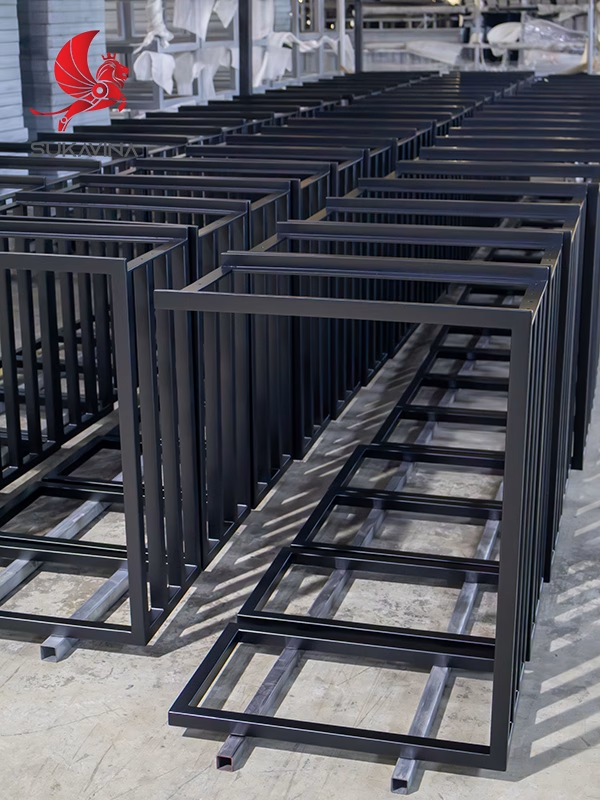
Surface finishing is where sample appearance and production reproducibility diverge most often. A single sample can be hand-coated with extra passes and hand-polished at every edge; a production batch is coated in larger runs with tighter cycle times. Buyers should treat the sample’s finish as a target specification to be locked down in writing, not as proof that every unit will look identical.
Practical checks may include measuring coating thickness with an appropriate gauge, verifying adhesion using the agreed test method where applicable, checking color consistency against an approved RAL or Pantone reference under controlled lighting conditions, and inspecting coating coverage at welds, corners, edges, and tube ends — areas that can be more difficult to coat consistently during production. For buyers sourcing furniture for coastal or high-humidity environments, corrosion resistance should also be considered at the material and coating specification stage. Where required by the project or applicable standard, salt-spray or humidity exposure testing can help verify whether the specified material and coating system provides the expected level of corrosion resistance under the intended service conditions.
Ask the supplier to provide the RAL or Pantone code, coating type, and target film thickness in writing before the sample is approved. Without a recorded reference, “matches the sample” becomes a subjective judgment call once production starts.
6. How Should Buyers Verify Hardware and Assembly Fit?
Hardware and assembly fit affect both the end-user experience and the buyer’s own logistics, since most metal furniture ships knock-down for container efficiency. At sample stage, buyers should confirm that bolts, screws, connectors, glides, and leveling feet match the specified grade and finish, and that pre-drilled holes align without forcing, over-tightening, or re-drilling on site.
A useful test is to assemble and disassemble the sample two or three times, checking whether fastener points loosen, strip, or lose alignment. If the frame requires force, shims, or an unlisted tool to assemble correctly, that is a defect to flag now, not a detail to overlook because the sample “still worked.”
7. What Documents Should Be Approved Before Mass Production?
Inspection results only protect a buyer if they are documented and signed before mass production begins. A complete pre-production approval package typically includes the sample approval report, a dimensional inspection report against the technical drawing, a written deviation list with buyer sign-off on any accepted variance, current material and finish specification sheets, and a revised drawing if any change was agreed during sampling.
This documentation should trace back to the original sourcing requirements. Buyers who took the time to prepare a complete furniture OEM RFQ at the start of the project generally find sample approval faster, because the drawing, materials, and finish were already defined before quotation rather than negotiated after tooling was committed. It is also worth revisiting how the buyer chose the supplier in the first place — the process used to compare furniture manufacturer quotes should have already screened for suppliers capable of meeting the frame’s specified metal furniture OEM specifications, so sample inspection becomes a confirmation step rather than a first discovery of capability gaps.
8. What Should Buyers Do When the Sample Fails Inspection?
Not every deviation from the drawing means the sample should be rejected outright. Buyers benefit from classifying deviations rather than reacting to them in isolation: critical deviations affect safety or structural integrity and require a new sample; major deviations affect appearance, fit, or function and usually require correction and re-inspection; minor deviations fall within acceptable variation and can be accepted with a documented note.
Whichever category applies, the response should be recorded in writing, not agreed verbally on a call. A deviation report should state what was found, how it compares to tolerance, what corrective action the supplier proposes, and whether a revised sample is required before final approval. Verbal approval given under time pressure is one of the most common reasons buyers later discover that mass production does not match what they thought they approved.
9. How to Approve a Metal Furniture Frame for Mass Production
Pulling the process together, a buyer-side approval sequence generally follows six stages, each one gating the next:
1. Technical Drawing — dimensions, tolerances, tube specification, and finish are confirmed and signed off before sampling starts.
2. Sample — the supplier produces a pre-production sample built to the approved drawing and specification.
3. Inspection — the buyer measures, tests, and records findings across dimensions, welds, alignment, load, finish, and hardware.
4. Deviation Review — any variance from the drawing is classified, discussed with the supplier, and either corrected or formally accepted.
5. Approval — the buyer signs a sample approval report referencing the final drawing revision and documented specifications.
6. Mass Production — production begins against the approved sample and documentation, with the golden sample retained as the reference standard for in-line and pre-shipment inspection.
Skipping or rushing any single stage weakens the buyer’s position later. A sample that was never formally approved in writing gives a buyer very little leverage if the finished container does not match expectations.
10. Buyer Metal Furniture Frame Inspection Checklist
Use this furniture frame inspection checklist as a working reference during sample review, and attach the completed checklist to the sample approval report.
- ☐ Dimensions and critical measurements match the technical drawing within tolerance
- ☐ Tube diameter, wall thickness, and material grade confirmed against specification
- ☐ Weld joints checked for penetration, consistency, and clean grinding
- ☐ Diagonal measurements and flat-surface test confirm squareness and stability
- ☐ Static load test performed and results recorded
- ☐ Coating thickness, adhesion, and color match verified against reference
- ☐ Coverage checked at welds, corners, and tube ends
- ☐ Hardware, fasteners, and pre-drilled holes fit without forcing
- ☐ Assembly and disassembly tested at least twice
- ☐ All deviations documented and classified in writing
- ☐ Sample approval report signed and dated before mass production release
11. Conclusion
A metal furniture frame inspection at sample stage is a buyer’s last opportunity to correct a design, tolerance, or finish issue before it becomes a production-wide problem. The most reliable inspections treat the sample as a measurable specification — dimensions, tube data, weld quality, load results, finish reference, and hardware fit recorded in writing — rather than a single object to be approved on appearance. Buyers who follow a structured technical drawing to mass production sequence, and who document every deviation and approval along the way, are far better positioned to hold the factory accountable if the production run drifts from what was agreed.
FAQs
1. How long should a buyer keep the approved sample after mass production begins?
The approved sample, often called the golden sample, should be kept by the buyer for the full duration of the order and ideally through the warranty period. It serves as the physical reference standard for resolving any dispute about whether production units match what was approved.
2. What dimensions should buyers measure during a metal furniture frame inspection?
Buyers should measure overall dimensions and all critical interfaces identified on the technical drawing, including tube length, leg spread, hole positions, mounting points, seat height, and diagonal measurements where applicable. The acceptable tolerance should be defined on the approved drawing rather than assumed from a generic industry value.
3. Can a buyer approve mass production based on photos alone?
Photos are useful for tracking progress but cannot verify dimensions, weld strength, load performance, or coating adhesion. Buyers who cannot inspect the sample in person should arrange a physical sample shipment or a third-party inspection before signing off on mass production.
Preparing a Metal Furniture Frame for Mass Production?
Sukavina Furniture works with international buyers on technical drawing review, sample development, and pre-production inspection for metal furniture frames. If you are preparing to approve a sample for mass production, our team can walk through the specification and inspection process with you.
- Address: Binh Chuan 44 St, An Phu Ward, Ho Chi Minh City, Vietnam.
- Hotline/WhatsApp/WeChat: +84 979 034 634 / +84 931 155 155
- Mail: sales@vietmetalfurniture.com
- Website: vietmetalfurniture.com/en