

 Tiếng Việt
Wardrobe vs. Armoire vs. Dresser: Understanding Bedroom Storage Furniture
What each piece does, when each one fits, and how bedroom storage should be evaluated for homes, multifamily housing and hospitality projects.
A wardrobe is a tall, freestanding cabinet built mainly for hanging clothes and often fitted with shelves or drawers. An armoire is a freestanding wardrobe-type cabinet with a more traditional or decorative character, and in North America the two terms often overlap. A dresser is a lower, horizontal piece with drawers for folded clothing and has no hanging space. In short: wardrobes and armoires store hanging garments, while dressers store folded items.
These three terms are used loosely in everyday conversation, and the looseness causes real problems in purchasing. A homeowner may search for an “armoire” and find wardrobes. A project buyer may specify a “wardrobe” and receive a quotation for a dresser-height unit.
This guide separates the three pieces clearly, then widens the view. In most bedrooms, and certainly in most projects, storage works best when it is planned as a system of pieces rather than chosen one item at a time. That shift in thinking matters for individual readers, and it matters even more for apartment developers, hospitality operators and the sourcing teams who buy for them.
1. What Is a Wardrobe?
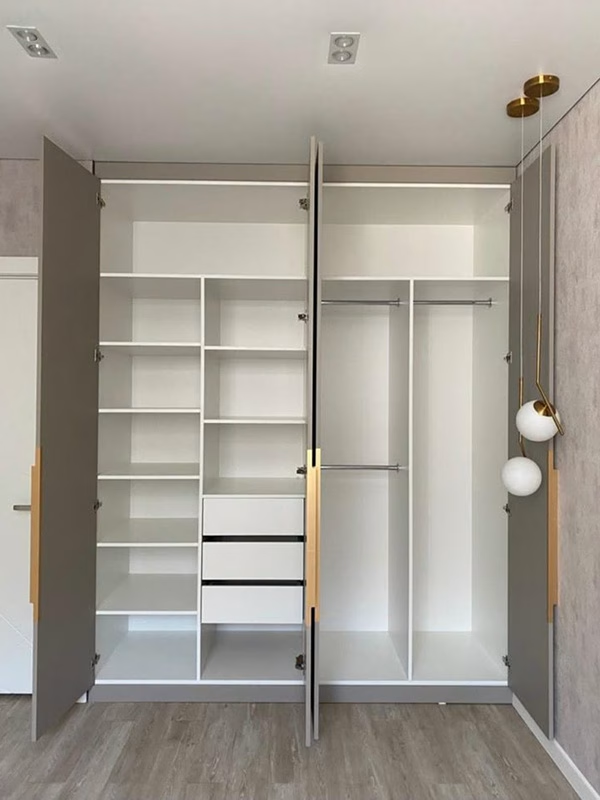
A wardrobe is a freestanding storage cabinet designed to replace or supplement a built-in closet. Its defining feature is a tall interior with a hanging rail, usually combined with shelves, drawers or both.
The term carries different weight in different regions. In Europe and much of Asia, “wardrobe” is the standard word for bedroom clothes storage, and it often describes large modular units with hinged or sliding doors. In the U.S., “wardrobe” usually means a freestanding closet-style unit, while “closet” refers to the built-in space in the room.
Because a wardrobe is a piece of furniture rather than part of the building, it can move with the occupant, be added to a room later, or be specified identically across many rooms in a project.
2. What Is an Armoire?

An armoire is a freestanding cabinet with doors, historically a decorative piece in the European furniture tradition. The word comes from the French for a large storage cabinet, and the style cues are usually traditional: paneled doors, crown moldings, carved or turned detail, and a visible base.
In the North American market, “armoire” is used in two ways. Some retailers use it for any freestanding wardrobe-type cabinet, particularly in a classic or transitional style. Others use it for cabinets whose interior is partly or entirely drawers and shelves, including media armoires that once housed televisions.
The practical distinction is often more about styling and positioning than structure. An armoire is typically chosen to be seen as a feature piece, where a wardrobe is more often chosen for capacity.
3. What Is a Dresser?

A dresser is a low, wide chest of drawers, usually waist height or a little taller, with a flat top that can hold a mirror, lamp or décor. It is designed for folded clothing such as T-shirts, knitwear, underwear, socks and sleepwear.
A taller, narrower version with stacked drawers is commonly called a chest of drawers or simply a chest. In older or regional usage, you may also see “bureau.” Retailers draw the line differently, but the function is the same: drawers, no hanging rail.
Because the top surface is usable, a dresser also contributes to the room’s layout and appearance, which is one reason it is rarely replaced by a wardrobe even when wardrobe capacity is generous.
4. Wardrobe vs. Armoire vs. Dresser: What Is the Difference?

The table below compares the three pieces on the points that most often decide a purchase. Dimensions and configurations vary by manufacturer, so treat the descriptions as general patterns rather than fixed specifications.
| Feature | Wardrobe | Armoire | Dresser |
|---|---|---|---|
| Main purpose | Hanging and mixed storage | Hanging or mixed storage, with a decorative role | Folded clothing and small items |
| Hanging space | Yes, usually the core feature | Often, but some are drawer or media units | No |
| Form | Tall, vertical, door-fronted | Tall, door-fronted, often with traditional detailing | Low and wide, drawer-fronted |
| Typical style language | Contemporary to transitional; functional | Traditional, French-inspired, or statement piece | Any style |
| Usable top surface | Limited | Limited | Yes |
| Visual footprint | Large vertical mass | Large vertical mass, strong presence | Horizontal, lower profile |
| Best suited to | Rooms with little or no closet | Rooms where furniture style is a priority | Almost every bedroom, alongside other storage |
The most useful way to read this table is by function, not by name. If the item has a hanging rail, it solves a different problem than one with only drawers, regardless of what the product page calls it.
5. When Should You Choose a Wardrobe?
Choose a wardrobe when the room needs hanging capacity that the building does not provide, or when flexibility matters more than permanence. It adds closet function without construction work.
Small bedrooms
In a compact room, a tall wardrobe uses vertical space that a dresser leaves empty. Sliding doors can also remove the clearance that swing doors require, which matters when the bed sits close to the wall.
Apartments and condos
Many apartments and condos have shallow or minimal closets. A freestanding wardrobe supplements them, and because it is not fixed to the building, a tenant can take it to the next home.
Guest rooms
A guest room rarely justifies a built-in closet, but guests still need somewhere to hang a few items. A modest wardrobe handles that without committing the room to a single function.
Rooms without built-in closets
Older homes, converted spaces, attic rooms and some basement bedrooms often have no closet at all. In some jurisdictions a room without a closet is still used as a bedroom, so a wardrobe is the ordinary solution. Local building rules vary, so confirm the requirements for the property in question.
Flexible interior layouts
Wardrobes can be configured with different mixes of hanging, shelving and drawers. That allows one footprint to serve different users, which is a clear advantage when the same room type is occupied by changing guests or tenants.
6. When Is an Armoire a Better Choice?
An armoire is the better choice when the cabinet is meant to be part of the room’s design, not just its storage. It suits traditional, French country, farmhouse and transitional interiors where a carved or paneled piece anchors a wall.
It also works where the interior needs to be flexible in a different way. Some armoires include drawers behind the doors, and some can be adapted to hold electronics, linens or accessories rather than hanging clothes.
The trade-off is that decorative detailing can add cost, weight and visual bulk. A buyer who simply needs hanging capacity may find a plainer wardrobe delivers more usable space for the same footprint.
7. When Is a Dresser the Better Choice?
A dresser is better when most of the clothing is folded, when ceiling height or sightlines limit tall furniture, or when the room needs a surface as well as storage. It is also the more natural choice beneath a window, a wall-mounted television or a mirror.
Drawers are easier to access than shelves, and a dresser requires no clearance for opening doors. In hospitality rooms, a dresser often takes on additional roles, such as holding a television, a luggage surface or a mini-bar, which a wardrobe cannot do.
A dresser does not replace a wardrobe where hanging garments matter. Used alone, it leaves coats, dresses and shirts without a home.
8. Wardrobe and Bedroom Storage: One System, Not One Product

The wardrobe-versus-dresser question is usually the wrong one. Most bedrooms need both kinds of capacity, and the real decision is how much of each, and where it sits.
A well-planned bedroom storage system typically combines several pieces, each with a clear job:
- Wardrobe or built-in closet for hanging garments and long items.
- Dresser or chest of drawers for folded clothing and everyday items.
- Nightstands for items needed within reach of the bed, which also reduces pressure on the main storage.
- Storage bed with drawers or a lift-up base for out-of-season bedding and luggage, particularly useful in small rooms.
- Bench or ottoman where space allows, for light storage and a place to sit.
This is where space planning begins. Door swing, drawer pull-out clearance, bed access and walking paths all compete for the same floor area, and a wardrobe that works on a product page may fail in a real room because its doors collide with a nightstand.
Storage should be specified per room type, not per product. When wardrobe, dresser, nightstand and bed are planned together, the dimensions, finishes and hardware can be coordinated, and the room reads as one design instead of a set of unrelated purchases.
Buyers who are weighing movable furniture against fixed joinery will also want to compare a freestanding wardrobe with a built-in closet. A freestanding unit offers flexibility and easier replacement. A built-in solution can use the full wall and ceiling height, but it commits the space and the budget at the construction stage.
9. What Should Buyers Consider When Choosing a Wardrobe?
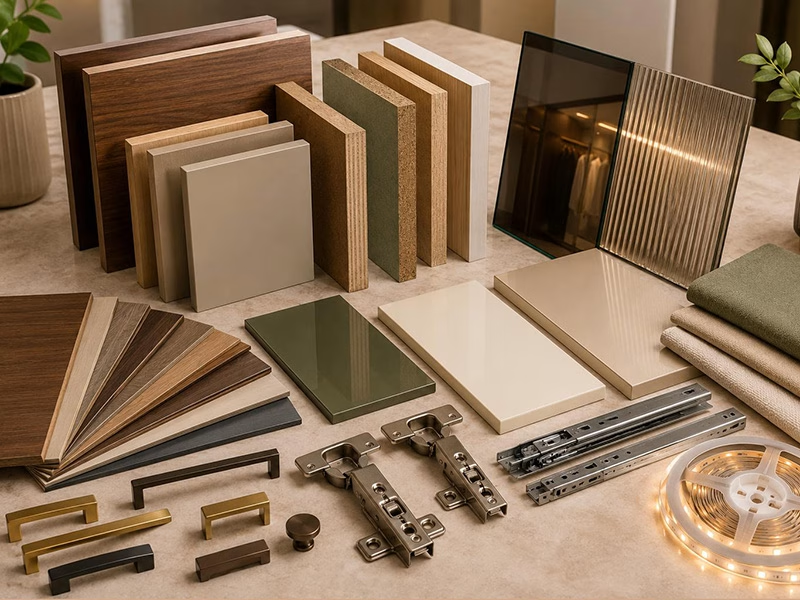
A wardrobe looks simple, but small specification differences change how it performs. The points below apply equally to a single purchase and to a quotation for hundreds of units.
Dimensions
Width, height and depth should be checked against the room, the doorways and the stairs, not just the wall. For hanging space, interior depth matters most: a depth of roughly 22 to 24 inches (about 56 to 61 cm) is commonly needed for standard hangers to sit squarely, while shallower units may force garments to hang at an angle. Confirm the exact interior clearance rather than relying on the exterior depth.
Internal configuration
Decide the split between hanging, shelves and drawers based on how the room will be used. A guest room may need mostly hanging space. A rental apartment may benefit from internal drawers, which can reduce the need for a separate dresser.
Door configuration
Hinged doors give full access to the interior but need clearance to swing open. Sliding doors save floor space but allow access to only part of the opening at a time. Mirrored doors can be useful in a small room, though they add weight and need secure mounting.
Materials
Wardrobes are commonly made from solid wood, plywood, MDF, particleboard or a combination, with veneer, laminate or melamine surfaces. Each choice affects weight, moisture behavior, repairability and cost. For a quotation to be comparable, the material of the carcass, the doors, the back panel and the shelves should each be stated, not summarized as “wood.”
Hardware
Hinges, drawer slides, sliding door tracks and hanging rails are the parts that users touch every day, and they are often where early wear appears. Specify the type and the intended load, and ask how each will be tested or checked against the buyer’s own requirements.
Finish
Finish affects appearance, cleaning and resistance to wear. In multi-room projects, consistency between production batches is as important as the finish itself, so approved samples and clear tolerance expectations should be agreed before production begins.
Assembly
Wardrobes are large, and the assembly model changes both cost and handling. Flat-pack units reduce shipping volume but require on-site assembly, while pre-assembled units reduce installation time but occupy more container space. Clear assembly instructions and a hardware count matter for either route.
Packaging
Tall panels and mirrored doors are vulnerable in transit. Packaging should protect corners and edges, label each carton clearly and fit an efficient container layout. For imports, carton dimensions and weights feed directly into freight cost, so they belong in the early quotation discussion.
Ask every supplier to state the interior dimensions, the thickness and material of each panel, and the hardware type in writing. Quotations that look similar on price often differ most in the details nobody listed.
10. How Does Bedroom Storage Change for Residential and Commercial Projects?
Project buyers are not choosing a wardrobe for one room. They are choosing a repeatable solution that must perform in every room of a given type, withstand frequent use and be procurable on a schedule. The core questions shift from preference to consistency, functionality, space efficiency and project requirements.
| Project type | Storage priorities | Key buyer considerations |
|---|---|---|
| Apartments | Maximum capacity in a small footprint | Compact dimensions, door type, ease of assembly in tight units |
| Multifamily housing | Repeatability across many units and turnover | Standardized specs, repairable surfaces, consistent replacement parts |
| Hospitality projects | Guest-friendly layout, brand-aligned design | Durability under frequent use, finish consistency, noise and safety in use, integrated pieces such as luggage and TV surfaces |
| Student accommodation | Dense storage in small rooms, resilience | Robust hardware, cleanable finishes, secure fixing where applicable |
Apartments and multifamily housing
In rental and for-sale apartments, storage is one of the most visible comparison points for residents. Supplying a coordinated wardrobe, dresser and nightstand set can make small rooms feel complete while keeping the layout predictable. In multifamily housing, a standard module that suits several unit types simplifies purchasing, installation and later replacement.
Hospitality
Hotel and serviced-residence rooms ask more of storage than most homes. The wardrobe often combines hanging space, a safe or luggage area and sometimes a mini-bar. Design intent also carries weight, because the furniture must match the brand’s finish palette across every room and, in many projects, across several buildings.
Student accommodation
Rooms are small and occupancy turns over frequently. Storage needs to be efficient, tolerant of heavy daily use and simple to maintain between occupants.
A developer is furnishing a multifamily building with studio and one-bedroom units. Rather than specifying a wardrobe for each unit type, the buyer defines a single wardrobe module and a matching dresser, then varies quantity per unit type. Finish, hardware and carton format stay identical across the order.
Illustrative scenario only. It does not describe a specific project or customer.
Projects may be subject to testing, fire-safety, emissions or anti-tip requirements set by the owner, the operator or the local jurisdiction. These vary widely by market and project type, so the applicable requirements should be identified at the specification stage and confirmed with the supplier, not assumed.
For project teams, the practical benefit of thinking this way is that a single design can be tuned to different room types, rather than starting over for each. That is also where custom development becomes relevant, since catalog items rarely match a project’s dimensions, finish palette and hardware requirements exactly. Buyers exploring that route can look at contract furniture programs and custom wardrobe manufacturing as the next step after choosing a storage concept.
11. Checklist: Before Issuing A Bedroom Storage RFQ
- ☐ Room types and unit mix confirmed
- ☐ Piece list defined (wardrobe, dresser, nightstand, bed)
- ☐ Exterior and interior dimensions stated
- ☐ Internal layout specified (hanging, shelves, drawers)
- ☐ Door type and hardware requirements listed
- ☐ Materials and surface finish defined for each component
- ☐ Applicable testing or compliance requirements identified
- ☐ Packaging and assembly approach agreed
- ☐ Destination and Incoterm confirmed
12. Conclusion
A wardrobe and an armoire both store hanging clothes, and the difference is mostly one of style and positioning. A dresser stores folded clothes and adds a working surface. They answer different needs, and most bedrooms need both.
For individual buyers, the best decision starts with how the room is used and what clothing it must hold. For project buyers, it starts with consistency, repeatability and a clear specification. In both cases, treating wardrobe, dresser, nightstand and bed as one storage system produces better rooms than choosing each piece alone.
Frequently Asked Questions
1. Is an armoire the same as a wardrobe?
Not always, but the terms overlap heavily in North America. Both are freestanding, door-fronted cabinets, and many are used for hanging clothes. “Armoire” usually signals a more traditional or decorative piece, and some armoires have drawers or shelves instead of a hanging rail, so check the interior layout rather than relying on the name.
2. Can a dresser replace a wardrobe?
Only if the occupant has very little hanging clothing. A dresser has no hanging rail, so it works for folded items but leaves coats, shirts and dresses without storage. Most rooms use a dresser together with a wardrobe or closet, not instead of one.
3. What should project buyers specify when ordering wardrobes in volume?
At a minimum: overall and interior dimensions, internal layout, door type, the material and thickness of each component, hardware, surface finish, assembly method and packaging. Any testing or compliance requirements from the owner or jurisdiction should be listed as well, so every supplier is quoting the same scope.
Planning a Bedroom Storage Program for Your Project?
Sukavina Furniture is an OEM/ODM furniture manufacturer working with international buyers on residential and commercial furniture. If you are developing wardrobes, dressers or coordinated bedroom storage for apartments, multifamily housing or hospitality projects, we are glad to discuss your drawings, specifications and requirements. This is also a natural starting point if you are comparing OEM/ODM bedroom furniture options or considering furniture manufacturing in Vietnam.
Discuss Your Project →- Address: Binh Chuan 44 St, An Phu Ward, Ho Chi Minh City, Vietnam.
- Hotline/WhatsApp/WeChat: +84 979 034 634 / +84 931 155 155
- Mail: sales@vietmetalfurniture.com
- Website: vietmetalfurniture.com/en