

 Tiếng Việt
Inside a Metal-Wood Furniture Factory: Production Tour at SukavinaFurniture 2026
⚡ Quick Answer — How does a closed-loop metal-wood furniture production system actually work?
An export-grade metal-wood furniture factory must operate as a closed-loop system — from fiber laser steel cutting, CNC hydraulic bending, MIG welding, and powder coating through to MDF machining, edge banding, and final assembly — all within a single, consistent quality control ecosystem. Only this model guarantees thousands of finished units to an identical standard, delivered on the strict project schedules that hotel and resort developments require. Rigorous control from the steel stock stage through to MDF moisture content is the core factor that earns the trust of international B2B partners placing large-volume export orders.
1. Infrastructure Scale & Project Furniture Supply Capability
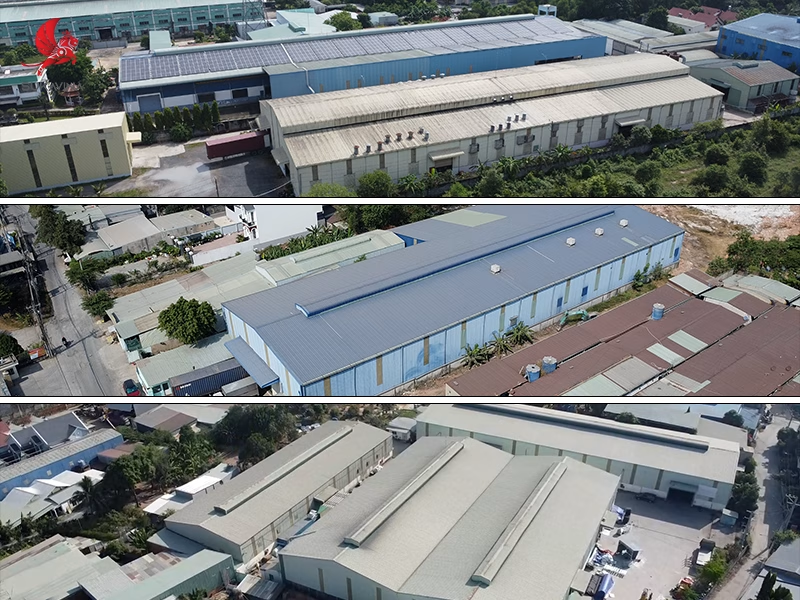
The first question any project contractor must resolve before signing a large-volume furniture procurement contract is: does this supplier genuinely have the production capacity to manufacture thousands of units to a completely consistent standard? That question cannot be answered by a product catalogue or marketing images — it can only be verified by walking through the metal-wood furniture factory itself. Smaller workshops that sub-contract individual production stages routinely encounter bottlenecks at the welding or powder-coating stage once orders exceed 300 units — producing delivery delays and colour variation between production batches.
SukavinaFurniture operates 3 workshops with a combined area exceeding 30,000m² in southern Vietnam — with the most significant recent development being the completion of a purpose-built engineered wood and MDF workshop expansion to over 10,000m², equipped with a dedicated temperature and humidity control system. This workshop does not share space with the metal fabrication line — a mandatory technical condition for controlling the equilibrium moisture content (EMC) of MDF panels before they enter CNC machining, preventing post-fabrication dimensional movement. The workforce of over 600 professionals — mechanical engineers, certified welders, industrial woodworkers, and QC inspectors — has completed multiple export batches to US and EU quality standards.
📊 3 workshops — 30,000m²
Metal, engineered wood, and finishing operations run in fully separate environments — independent quality control per stage, no cross-contamination between production processes.
🏊 10,000m² MDF workshop
Dedicated engineered wood facility with active humidity control — guarantees EMC 8–12% before CNC machining, the non-negotiable standard for products exported to cold-climate markets.
👥 600+ skilled professionals
Mechanical engineers, welders, industrial woodworkers, and dedicated QC staff — not shared with general-purpose contract manufacturing, maintaining full focus on export quality standards.
💡 What to ask during a supplier factory visit
When visiting any metal-wood furniture factory, ask directly: “Are the woodworking and metal fabrication workshops physically separate?” and “What instrument is used to measure MDF moisture content before machining?” A professional facility answers immediately with specific data. A workshop that is not yet at that standard will be evasive or will not have the measuring equipment on hand.
2. High-Tech Production Philosophy: The Power of Automation Technology
Stepping into the heavy fabrication workshop of this metal-wood furniture factory, the first impression is the steady hum of laser cutting machines and a faint warm-metal scent drifting through the air. There is no disorganised noise — every machine runs on a pre-programmed production schedule, every steel section passing through each station in an unbroken sequence.
💥 Precision Stock Cutting via Fiber Laser CNC
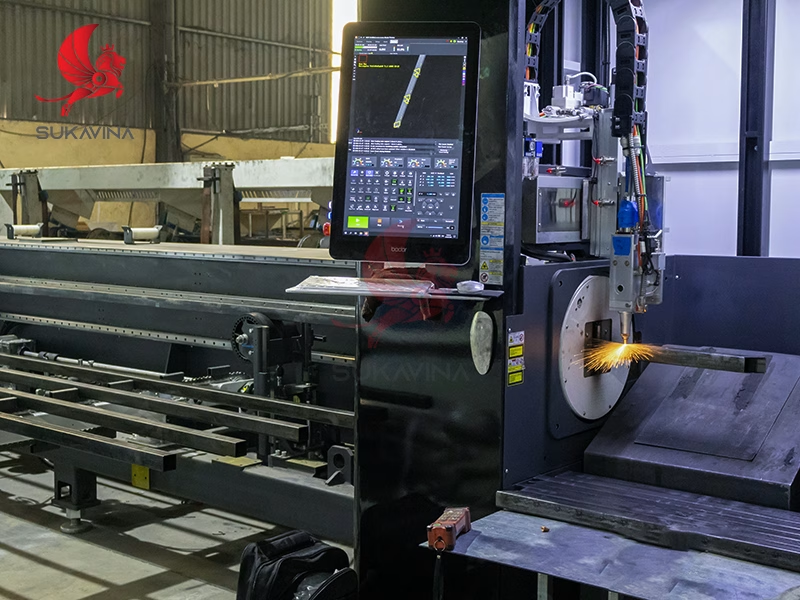
The first station in the production sequence is the fiber optic laser cutting bed. All technical parameters from the CAD/CAM drawing are loaded into the controller — the machine automatically schedules cutting paths to optimise sheet steel utilisation and minimise material waste. The fiber laser at a 1,064nm wavelength cuts box-section steel tube and flat sheet to a tolerance of ±0.1mm, producing a clean edge with zero burr that requires no secondary operation before moving to the bending stage.
What matters most for large orders is this: 1,000 steel tubes cut from the same CNC program are dimensionally identical to within one-tenth of a millimetre. This is the foundation that allows 1,000 assembled furniture units to fit together perfectly — no manual adjustment on any single piece. The precision metal fabrication system is self-contained from raw steel stock through to laser cutting — no external dependency at this most critical stage of the process.
⚙ Forming and CNC Hydraulic Press Brake Bending

After cutting, steel stock moves to the CNC hydraulic press brake. This is the stage that determines the overall form of each frame — precise 90-degree technical angles, table leg curves, and asymmetric angle profiles are all formed here. Controlled hydraulic force produces sharp, clean steel bends at the exact design angle without surface cracking or metal distortion — something manual bending cannot replicate with consistent accuracy across hundreds of successive units.
For complex designs such as modern metal frame nightstands where the enclosing steel frame must achieve an overall ±0.3mm dimensional tolerance to allow a precision MDF insert, the CNC press brake is the only equipment capable of meeting this requirement consistently at a rate of hundreds of units per day.
💡 Why the press brake is the most revealing machine in a factory visit
When touring any metal-wood furniture factory, ask to watch the press brake operating and randomly pick 3 completed bent sections for angle measurement. If the three angles are not consistent within ±1°, that factory does not have the production control required for large-volume project orders where steel frames must mate with precision-machined MDF inserts.
3. High-Touch Production Philosophy: The Craft of Skilled Artisans
Machines produce consistency. People produce excellence. This is the principle that any export furniture manufacturer that genuinely understands its craft operates by — not a slogan on the wall. Once steel components leave the automated production line, skilled craftsmen receive the semi-finished parts and begin the stages that no sensor or robot can replace at this point in the process.
🔨 Steel Frame Welding & Weld Seam Surface Treatment
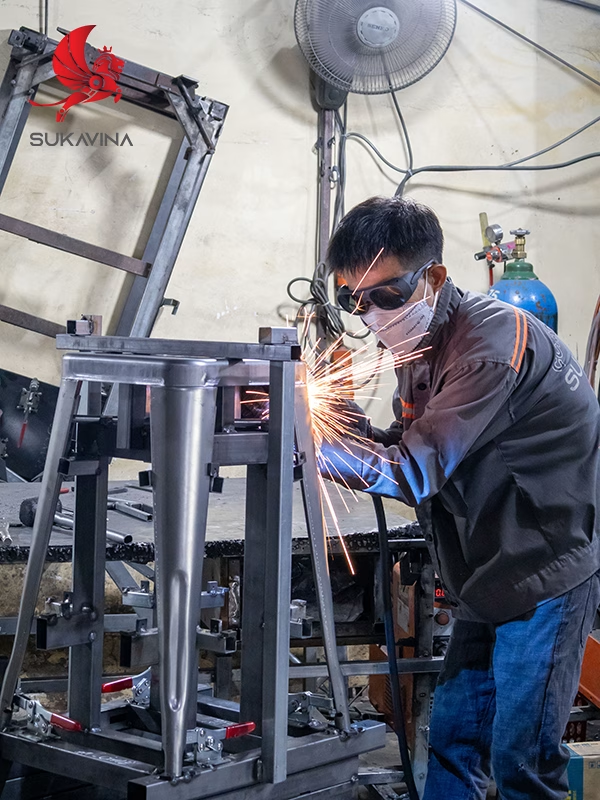
In the welding workshop, cut and bent steel sections are loaded into dedicated welding jigs. The jig positions all frame angles, wall spacings, and flat planes precisely before welding begins — eliminating the human variable in part positioning. Deep-penetration MIG welding is applied to all high-load structural joints — particularly at the connection points of table frames, bed frames, and furniture types subject to repeated loading in commercial operating environments. For a detailed technical explanation of why weld technique at the metal-to-wood connection point directly affects product service life, see: the secrets of metal-wood joinery in furniture manufacturing.
After welding, skilled craftsmen begin the grinding sequence. The progression 60 → 120 → 240 → 400 grit is worked through on each weld seam individually. The objective is to bring the weld face to a surface roughness of Ra 0.8–1.6μm — not for visual finish, but to give the subsequent powder-coat layer the best possible mechanical adhesion substrate, preventing the air pockets and pinholes that would compromise the aesthetic of the finished surface. This stage cannot be accelerated or abbreviated at any step without sacrificing the true export standard.
🎨 Industrial Woodworking & Metal-Wood Joinery Techniques in Practice
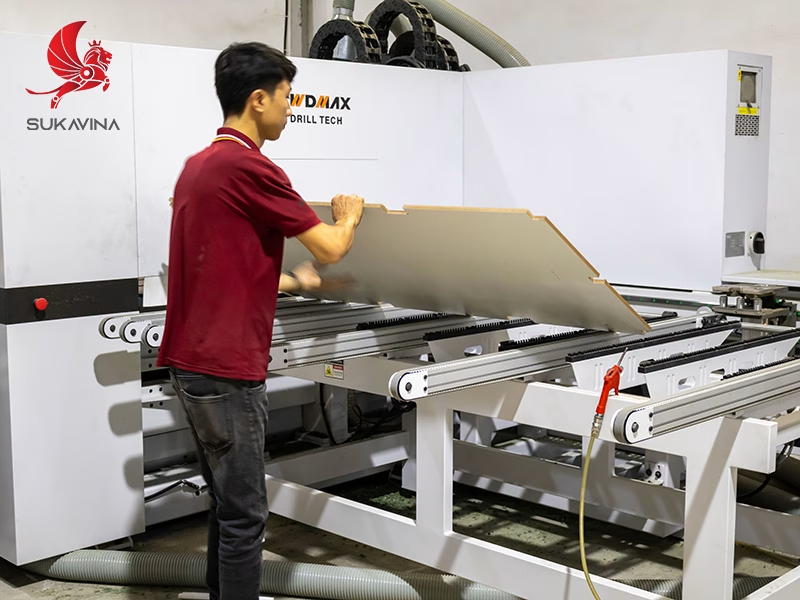
CNC MDF machining — ±0.1mm tolerance
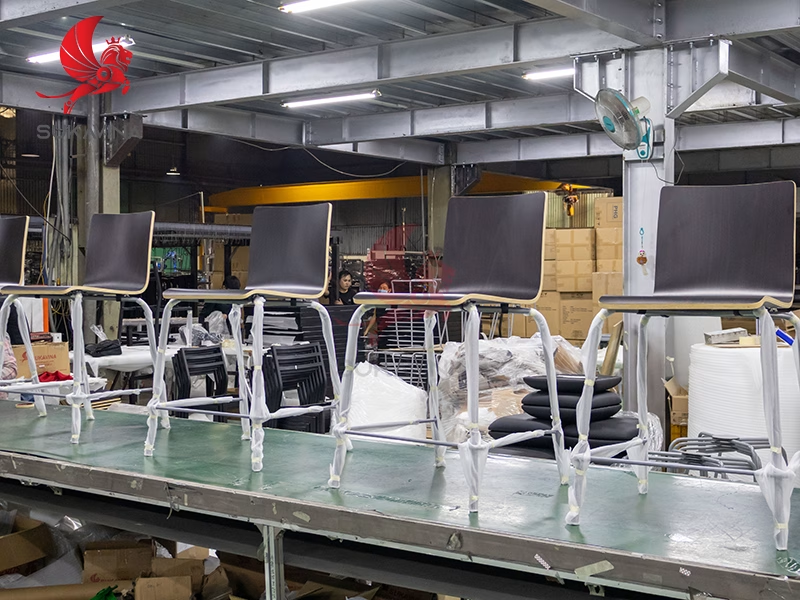
Metal-wood assembly — joint fit inspection
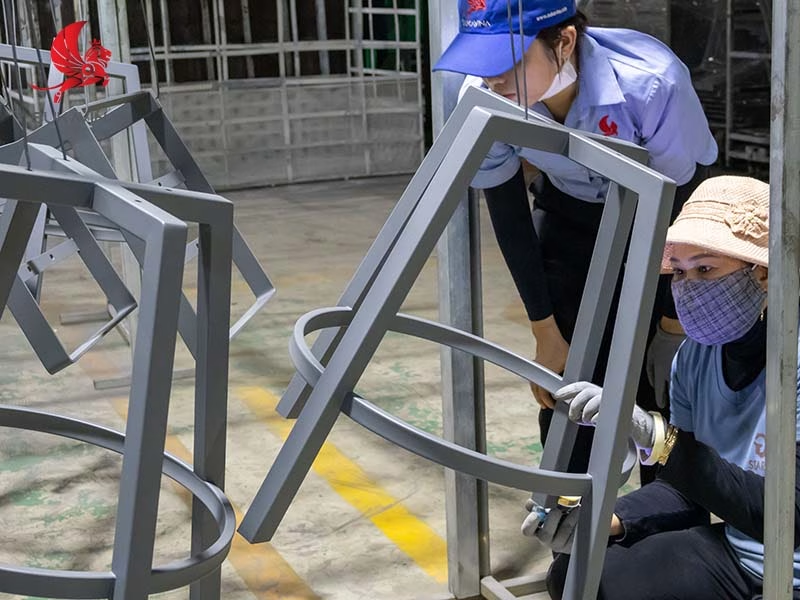
Powder coating — 60–80μm after phosphating
In the MDF workshop — over 10,000m² in area — the woodworking process begins with a moisture measurement check on every incoming batch of green-core moisture-resistant E1 MDF using a pin-type moisture meter. Only batches confirming EMC 8–12% are cleared for CNC machining. After the CNC centres cut and profile all wood components, every cut edge — including the internal edges of routed channels and holes — passes through a heavy-duty automatic edge-banding machine applying PVC strip with high-temperature EVA adhesive, creating a complete moisture-barrier seal.
The most distinctive aspect of this stage is the coordination between the woodworking team and the metal fabrication team: at every connection point between a wood drawer unit and its enclosing steel frame, woodworkers drill oval slotted holes to match the exact laser-cut slot positions on the steel section, then drive brass threaded inserts into the MDF core using torque-controlled tooling — the direct practical application of metal-wood material bonding techniques in high-volume serial production. When the wood unit is assembled into the steel frame, the fit is completely flush and tight — no rocking tolerance, no surface scratching during assembly.
This process is applied consistently across all product lines — from seating furniture to box-section steel table and chair fabrication with wood surfaces — ensuring identical joint standards across the full production batch.
💡 How to identify an export-ready woodworking facility
When visiting the wood workshop of any metal-wood furniture factory, pick up a finished MDF panel and run a fingertip along the edge. If the edge is flat and smooth, the PVC strip is bonded firmly with no gaps and does not lift when gently pressed with a fingernail — the edge-banding machine is up to standard. A rough edge or uneven PVC bond is a direct warning that the cabinet will suffer edge swelling within 6–12 months of operation in cold-climate or air-conditioned environments.
4. Conclusion
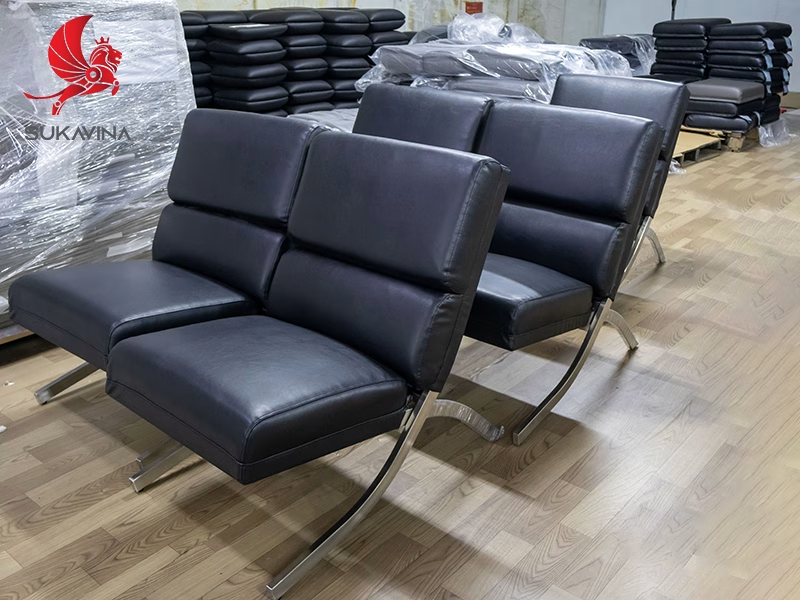
An export-grade furniture product is not a random outcome — it is the convergence of production infrastructure at the right scale, automation technology programmed correctly, and the deep technical judgement of skilled craftsmen at every stage. When any one of these three elements is missing, the product may appear satisfactory on visual inspection but will not hold up after 12–18 months of actual operation in the export market.
For B2B partners seeking a metal-wood furniture factory with fully self-contained capability from metal through to engineered wood, SukavinaFurniture in Ho Chi Minh City — with 3 workshops, over 30,000m², a dedicated 10,000m² MDF facility, and 600+ experienced professionals — provides the assurance of consistent quality, dimensional tolerance control, and on-time delivery for large-scale project contracts.
Contact us to arrange a direct factory visit or receive production solution consultation for your project.
5. Frequently Asked Questions from Contractors During Factory Visits
❓ How does the factory control engineered wood moisture content to prevent products from warping when exported to cloud climates?
All incoming green-core moisture-resistant E1 MDF panels are stored in the 10,000m²+ workshop equipped with an independent ventilation and humidity control system. Before any batch is loaded into the CNC machine, a QC inspector measures the moisture content of every panel using a pin-type meter — only batches confirming EMC 8–12% are cleared for machining. The 8–12% range corresponds to the equilibrium moisture content of most air-conditioned indoor environments across North America and the EU, meaning the timber has been pre-adapted to its final operating conditions before leaving the factory — there is no residual shrinkage after installation at the project site.
❓ At which stages of the closed-loop production process is the factory’s quality management system (QA/QC) deployed?
The QC process is structured across 3 independent layers: Layer 1 — Input stock QC: dimensional verification of steel stock after laser cutting and MDF moisture confirmation before CNC machining. Layer 2 — Semi-finished goods QC: dimensional tolerance check of welded steel frames (±0.3mm), weld seam inspection under raking light, and PVC edge-banding bond quality check after the banding machine. Layer 3 — Finished goods QC: 100% of units pass a complete assembly fit-test before packing — checking frame-to-wood clearance, measuring ΔE colour variance between metal and MDF surfaces (acceptance standard <1.5), verifying mechanical connection durability, and full visual inspection against the approved golden sample.
❓ Can the factory produce custom designs from a contractor’s proprietary drawings, or does it only manufacture from an existing catalogue?
This is the core capability that separates a genuine ODM/OEM metal-wood furniture factory from a catalogue-based reseller. The in-house technical team accepts drawings from architects or the client’s design department in any format — DWG, PDF, or STP 3D. Mechanical engineers analyse mass-production feasibility, confirm dimensional tolerances, and propose structural adjustments where needed (and only with written architect approval before proceeding). Mock-up prototypes of 1–3 units are then produced within 15–20 business days. Each prototype is load-tested and visually inspected against specification before being presented to the customer for full-production approval — there are no surprises when the main production batch ships.
Partner With a Trusted Manufacturer
Sukavina Group — Empowering Global Partners with Reliable and Expert Metal Furniture Solutions.
REQUEST A QUOTE NOW📍 SUKAVINA CO., LTD.
• Address: Binh Chuan 44 St, An Phu Ward, Ho Chi Minh City, Vietnam
• Hotline: +84 979 034 634 / +84 931 155 155
• Mail: sales@vietmetalfurniture.com
• Website: vietmetalfurniture.com