Mechanical fabrication is the core factor that determines quality in wood seat metal leg chair manufacturing. From the precision of the metal frame and welding techniques to surface finishing, every stage directly impacts durability, stability, and the premium feel of the final product, especially for metal leg bar stools with wooden seats used in restaurant and hotel environments.
Mechanical Fabrication
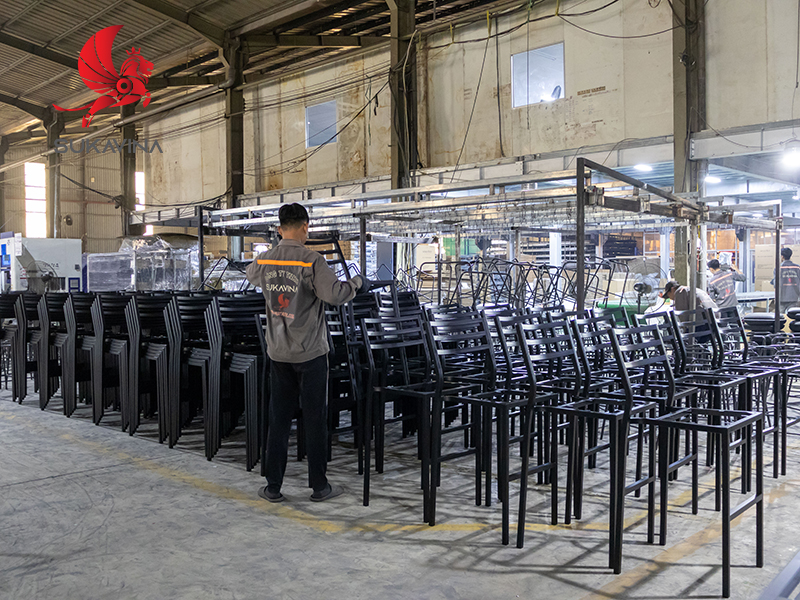
In wood seat metal leg chair manufacturing, the metal frame serves as the primary load-bearing structure. However, what truly matters is not just the steel itself, but how it is processed and joined. Precision mechanical fabrication ensures uniformity across metal components, resulting in a stable and consistent overall structure.
In high-quality products, particularly metal leg bar stools, frames are often CNC-cut or laser-cut to achieve near-perfect accuracy before welding. This minimizes assembly deviations while preserving the intended design lines and proportions.
It is no coincidence that in hospitality interior projects, furniture with refined mechanical finishing delivers a noticeably solid and reliable user experience—subtle in appearance, yet impactful in use.
Structural foundation of wood seat metal leg chairs
Frame Welding Techniques
One of the most critical aspects of wood seat metal leg chair manufacturing lies in frame welding. This is where product quality can either be elevated or compromised.
Weld joints in premium metal chairs must not only be strong but also clean, consistent, and properly ground afterward. When executed correctly, these joints distribute load evenly across the structure, preventing wobbling over time.
For wood seat metal leg bar stools, this requirement becomes even more critical due to their height and frequent use in high-traffic environments such as bars and restaurants. A well-welded frame maintains stability even under continuous load.
In experienced manufacturing facilities, welding processes are standardized and paired with multi-stage quality control. This ensures that every product meets the same level of precision and finishes.
One of the key factors is frame welding technique
Metal Surface Finishing
After frame fabrication, the next step in wood seat metal leg chair manufacturing is metal surface treatment. This stage goes beyond aesthetics—it directly influences product lifespan.
Powder coating is widely used in high-end metal furniture. It enhances resistance to scratches, corrosion, and daily wear while maintaining consistent color over time. In humid or high-use environments such as hotels and restaurants, this coating acts as a protective layer that preserves both appearance and performance.
Equally important is the pre-treatment process before coating, including cleaning, degreasing, and surface texturing. A well-executed process ensures strong coating adhesion and a smooth, refined finish that contributes to the overall premium feel.
One of the key challenges in wood seat metal leg chair manufacturing is achieving harmony between two materials with very different characteristics. Metal offers strength and structure, while wood provides warmth and natural texture.
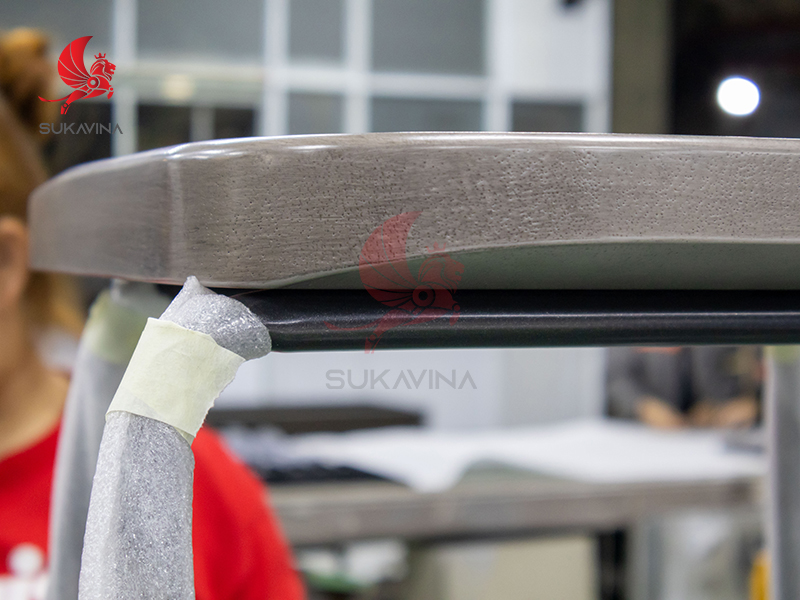
Wooden seats are carefully processed through drying, anti-warping treatment, and surface finishing to ensure long-term stability. When combined with a precisely fabricated metal frame, the result is a balanced product in both aesthetics and functionality.
In metal leg bar stool designs, this balance becomes more evident. Wooden seats are often slightly curved or ergonomically shaped to enhance comfort. This is not merely a design choice, but the result of close coordination between mechanical fabrication and wood processing techniques.
The ability to integrate metal and wood materials
Optimization for Mass Production and Export
At scale, wood seat metal leg chair manufacturing requires full process consistency. Mechanical fabrication not only ensures product quality but also enables efficient mass production.
Standardized components streamline assembly, reduce errors, and maintain consistency across production batches. This is especially critical for export orders, where every unit must meet identical specifications.
Additionally, optimizing metal frame structures helps reduce weight without compromising strength. This plays an important role in logistics, lowering shipping costs while maintaining product integrity.
Ultimately, wood seat metal leg chair manufacturing is a process that demands a refined balance between engineering and design. Mechanical fabrication is not just a production step, it is the foundation that defines product value, from durability and stability to the overall user experience. At Sukavina, wood seat metal leg chairs and metal frame bar stools are developed based on precision mechanical fabrication, combined with a professional manufacturing process. This ensures that every product meets strict requirements in durability, aesthetics, and international export standards.


 Tiếng Việt